Know your rights
The fee cap exists. It is not being enforced.
This is the single most important thing we can tell you before you sign anything with a company offering to get your Disability Tax Credit for you.
What the law says
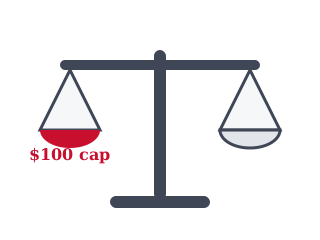
Parliament passed the Disability Tax Credit Promoters Restrictions Act in 2014. It makes it an offence for a “promoter” to accept or charge more than a maximum fee for helping with a Disability Tax Credit request, and it sets real penalties for doing so. The accompanying regulations set that maximum fee at $100 — $100 for a request for a determination of eligibility, and $100 per taxation year for a request relating to a deduction.
What is actually happening
The Act and the regulations came into force on 15 November 2021 — and were immediately suspended. In the Canada Revenue Agency’s own words:
“Due to a court injunction, the Disability Tax Credit Promoters Restrictions Regulations are suspended until further notice.”
“The Disability Tax Credit Promoters Restrictions Act and the Regulations came into force on November 15, 2021, but they have been suspended from operation pending the outcome of a litigation. … Any enforcement of the maximum fee set by the Regulations will come into effect once the Regulations become operable.”
— Canada Revenue Agency, Questions and answers to the Disability Tax Credit Promoters Restrictions Regulations
So the protection Parliament wrote for you is on the books, but suspended. Until the litigation resolves and the regulations become operable, there is no enforced ceiling on what a firm can charge you for help with a DTC application — which is why contingency fees of 25% to 30% of your refund are still common practice.
That gap is the reason this society exists.
What the Act threatens — when it is operable
The Act is not toothless on paper. A promoter who charges more than the maximum fee is liable on summary conviction to a fine of not less than 100% and not more than 200% of the amount by which the fee exceeded the maximum, and to a penalty of $1,000 plus a further amount set by formula. Promoters are also required to notify the CRA when they charge more than the maximum.
None of that is being enforced while the regulations are suspended. It is worth knowing anyway, because it tells you what Parliament thought of the practice.
Before you sign with anyone
If you are considering a company that offers to handle your application, take these steps first. They cost nothing and they are yours by right.
- Ask for the fee in dollars, not percentages. “25% of your refund” on a ten-year approval is not a small number. Ask them to estimate it in dollars, in writing.
- Ask what happens if you are approved anyway. Many people are eligible with nothing more than their own practitioner’s certification. You may be paying a percentage for something that would have happened regardless.
- Read the assignment and authorisation clauses. Understand exactly what you are authorising them to do with the CRA on your behalf, and how to revoke it.
- Check the cancellation terms — whether you can withdraw, when, and at what cost.
- Remember that applying is free. The CRA does not charge for the form or the application. Take the time to get independent help before committing a share of your money.
Warning signs
- Pressure to sign quickly, or a “limited time” offer
- A promise or guarantee that you will be approved — nobody but the CRA decides that
- Reluctance to state the fee as a dollar figure
- Any suggestion that they have a special relationship with, or work for, the CRA
- Being told you cannot apply on your own, or that your case is too complicated to do without them
If you have already signed
You are not out of options, and you have not done anything wrong. Look at your agreement for its cancellation and revocation terms, and find out whether the work has actually been submitted yet. If you believe a fee charged to you was improper, you can raise it with the Canada Revenue Agency, and you may wish to get independent legal advice — particularly where a large retroactive refund is involved. We are happy to help you understand what you are looking at, at no cost. We cannot give you legal advice, but we can help you find your footing.
Nobody is entitled to a share of your Disability Tax Credit. Not a firm, and not us. If you want help, ask us — and if you would rather do it yourself, we will help you do that too.